top of page

AX Molding Co., Ltd.
Specialized manufacturer of T-dies and feed blocks
We can handle a variety of applications, including high-precision thin film dies, sheet dies, and multi-layered products.

Hastelloy Die
Example of fluorine corrosion-resistant T-die
The specifications of the T-die that are compatible with each type of fluororesin will vary. There are various types of fluororesin, including PTFE, FEP, PFA, and ETFE. PTFE is generally molded by compression molding, but other fluororesins can be molded by extrusion, and the specifications of the T-die must be changed in order of increasing corrosion resistance.
High corrosion resistance: Hastelloy T-die. Slightly high corrosion resistance: Nickel-based electroless plating + chrome molybdenum steel. Low corrosion resistance: Hard chrome plating + chrome molybdenum steel. Melting temperature: 350°C (depending on type).
Electroless plating and hard chrome plating require maintenance, such as stripping and regrinding every six months to several years. Hastelloy T-dies are made of a very expensive and difficult-to-cut material. Hastelloy is several dozen times more expensive than chromoly steel, and the processing time is several times longer, making it significantly more expensive than standard T-dies. However, because it is less corrosive, it is not affected by corrosive gases even when stopped for several hours and restarted. Hastelloy dies are also highly deformable and prone to bending. Even when used new, the T-die's centerline can become misaligned after several dozen uses or after being lifted. The bending value can be as much as 1-2 mm per 1000 mm. Repairs are also recommended every few years. By straightening the die's exterior and re-polishing it, it can be restored to like-new condition. Separately, if corrosion resistance is high, lip adjustment bolts and die body clamping bolts may be electrolessly plated to protect against corrosion from corrosive fluorine gases. In some cases, this plating can extend the time between replacements due to corrosion by several years.

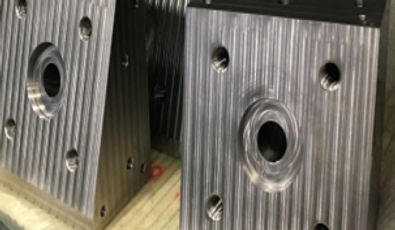
<Our production results: Hastelloy dies> (reference photo)


<Why is Hastelloy difficult to process?>
Hastelloy is a material that is prone to work hardening, and the frictional heat generated by the tool during machining places a heavy burden on the tool, causing tool wear several times faster than with normal materials. This means that cutting speed adjustments must be managed very strictly.
We are well versed in the basic processing methods for large T-dies and have been involved in the manufacture of Hastelloy T-dies for many years, so we have in-depth know-how for processing and are proud to produce 3 to 4 fluorine-use Hastelloy dies, necks, and feed blocks per year.
<Features of Fluorine T-Die>
Also, since it has the property of corroding metal, all resin passages must be made from Hastelloy.
Neck Block/Feed Pipe
Cylinder and screw (corrosion resistance)


In addition, the temperature required to heat-melt fluororesin is higher than that required to heat-melt ordinary olefin-based resins (general-purpose resins such as PP, PET, and PE).
<Molding temperature (reference)>

Fluoropolymers in particular heat the equipment (T-die, feed block) at high temperatures, so the temperature difference between the outside air temperature and the T-die is large, and there is a strong force constantly lowering the temperature from the outside air temperature. T-die temperature control is extremely important not only for fluoropolymers but for all resin extrusion molding. T-die temperature control is performed by allocating thermocouples (thermosensors) to the heater zone of the die, but the temperature at this time is picked up near the sensor, and this is merely a method of detecting and controlling the "heat near the sensor."
We have thoroughly investigated the heat distribution in the T-die itself , and have designed it with particular attention to the heating part.
<Photo of the T-die during production (for reference)>


The optimum solution for verifying the heater's heating distribution will vary depending on various factors, such as the width of the T-die, the type of fluororesin being extruded, the capacity of the primary power supply being used, etc. We continue to propose better designs based on the results of our analysis.
Please feel free to contact us if you have any problems or concerns.
bottom of page