top of page

AX Molding Co., Ltd.
Specialized manufacturer of T-dies and feed blocks
We can handle a variety of applications, including high-precision thin film dies, sheet dies, and multi-layered products.

Flow path analysis
< Flow path design for film T-dies >
For film production, especially in thin film molding, maintaining uniformity of the resin coming out of the lip is an absolute requirement for maintaining quality. In order to maintain a uniform film thickness of the resin extruded from the T-die lip, the quickest way to produce high-quality film is to carefully design the invisible flow path inside the T-die. Based on the results of flow analysis and past experience, we conduct flow analysis before the actual design to create the optimal flow path design to meet the customer's production needs.
Resin Data
(Provided by the customer)
Create a viscosity curve from a formula


The pressure, residence time, and flow rate inside the die are simulated using a resin viscosity model.


⭐️Here's the difference! Flow path analysis with T-die stress deformation included (AXM analysis method)
T-dies for film tend to have high pressure inside them due to the narrow lip gap. The lip of the T-die acts as a flow path (manifold), so the area where the resin flows is hollow. Naturally, when a large amount of resin is extruded from the extruder, a phenomenon known as "mouth opening" occurs, where the center of the outlet near the lip swells. Even when this phenomenon occurs, unless the flow path is designed to ensure that the resin extruded from the lip is uniform, quality cannot be maintained during actual mass production. At Axe Molding, we design our products to be able to mold stable film even when this phenomenon occurs (during actual mass production extrusion).
① Using the characteristics of the metal material of the T-die as a model, input the pressure data acting inside the T-die from the internal pressure data of the input destination, and calculate the amount of change in the lip gap that will occur during actual mass production.


Pressure unit: Mpa

Dwell time unit: seconds

flow rate
Unit: Cm/s
⭐️Here's the point!
Compare two sets of data in a graph

<Screw flow analysis>
We also perform 2.5D analysis of screws using the same flow analysis method used for T-dies. We input the customer's resin data into the modeled screw shape and provide a wide range of support, from analyzing existing screws to proposing new screws.
.png)
A viscosity curve is created from resin data and then applied to the model for simulation.
<Example: Analysis of a screw with various compression ratios changed before production>


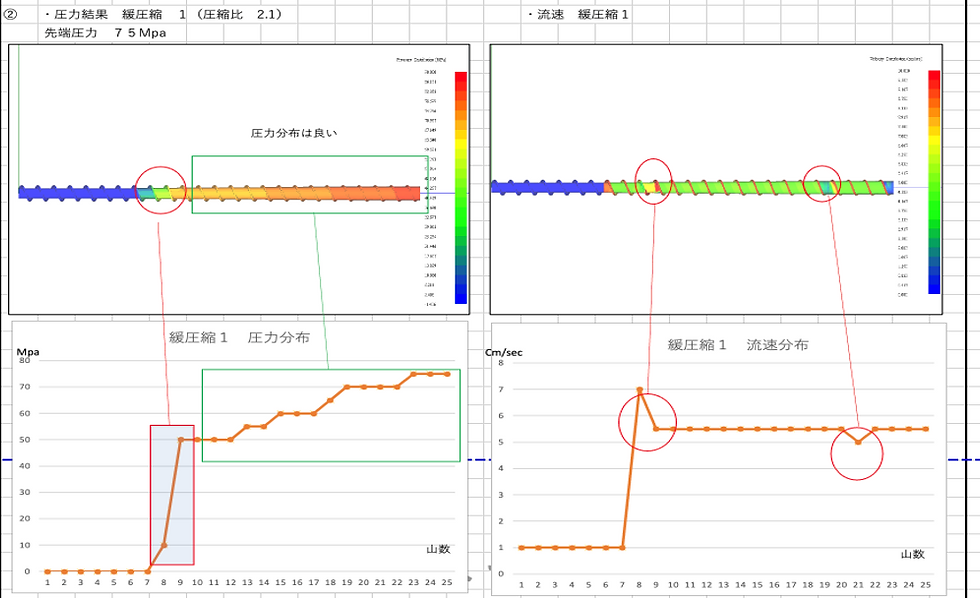

By conducting analysis in advance and predicting the pressure and flow rate when resin is dispensed, it is possible to predict to some extent the behavior inside the cylinder before testing.We believe that by utilizing analysis data, it is possible to shorten the trial and error time required for mass production launch and development testing of new products.
<Analysis of the confluence inside the feed block>
Resins with different discharge rates and viscosities flowing in from the extruder must be adjusted to equalize the flow speed and pressure of the resins at the confluence by adjusting the manifold gap inside the feedblock. By equalizing the pressure of each resin, it becomes possible to maintain uniform appearance and layer ratio of the multilayer film, as well as film thickness accuracy. Designing a multilayer feedblock requires knowledge of resins and the know-how to achieve the product layer ratio desired by the customer.

<Graphic representation of layer structure from analysis data>
In multi-layer extrusion molding, different materials are poured into the skin layer and core layer to create a multi-layer structure, so it is necessary to design a feed block that ensures uniform pressure and flow rate for the gaps in the flow path. We actively undertake flow analysis of multi-layer feed blocks, which are considered relatively difficult to understand, and we often assist customers in the production of high-performance multi-layer films by mutually discussing the matter with them before mold manufacturing.

Our strength is that we can perform thorough analysis before design. Of course, we also accept analysis of existing T-dies owned by customers. Please feel free to contact us with any concerns you may have, no matter how small!
bottom of page