top of page

AX Molding Co., Ltd.
Specialized manufacturer of T-dies and feed blocks
We can handle a variety of applications, including high-precision thin film dies, sheet dies, and multi-layered products.

Film Die
Features of T-dies for film
T-dies for film have a lip gap of 0.1mm to 1mm. Film is used in a variety of fields, including optical, food, and medical applications.
To make the film thinner, it is stretched in a later process to make it 0.01 mm thick.
Here are some of the features of film dies.
Because the lip gap is small, a large amount of pressure is applied when the resin comes out, and the T-die body is designed to withstand the internal pressure. This affects the surface and thickness of the film,
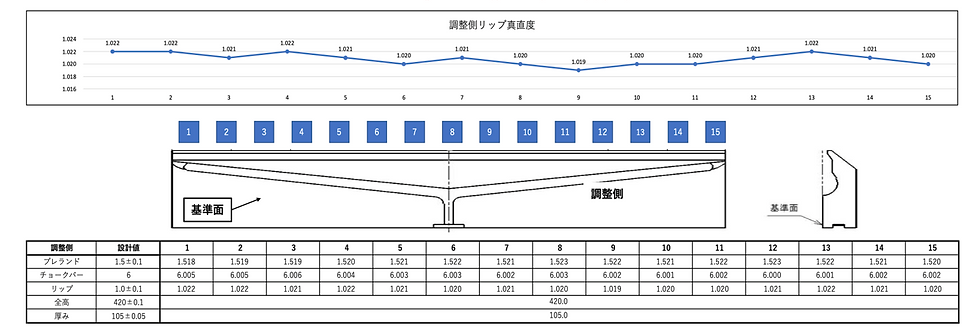
The lip land (the tip of the flow surface outlet) is polished more precisely (Ra 0.05 μm or less) and manufactured with better accuracy in center straightness (0.005 mm/1000 mm width).
To ensure film thickness accuracy, the lip edge must be sharp (R 0.1 or less). There must also be no small chips on the edge.
As the resin coming out of the T-die narrows in width (neck-in) before engaging with the roll, the tip angle of the T-die's outer shape is made acute so that it can be as close to the roll as possible. To allow for more precise thickness accuracy, a large number of lip adjustment bolts are manufactured to allow for more precise adjustment. As film is often made of transparent resin, resin retention inside the T-die is undesirable. Therefore, the flow path is designed to be as short as possible, with a short lip land and no choke bar.

< Film die reference photo >


<Straightness and lip precision are crucial for film dies>
Tダイの精度 真直度、平行度、平面度、面粗さ、リップの先端Rの考え方
・Tダイの真直度
Tダイの納品前の静的精度はとても重要です。
Tダイはリップの芯直度とTダイ合わせ面の平行度でリップの隙間精度が決まります。
リップの芯直度が良くても、Tダイ合わせ面の平行度が良くなければ、Tダイの樹脂厚みに変化が出ます。
・流路部の面粗さ
Tダイの面粗さは、Tダイの樹脂離れで重要な要素です。
面粗度が良ければ、Tダイマニホールド内の面に、樹脂が張り付かずに滑って押し出されるので、大きな問題となりませんが、面粗度が悪ければ、Tダイマニホールド内の面に樹脂が張り付いてしまうので、張り付いた部分だけ樹脂の滞留時間が長くなり、樹脂焼けの原因となります。
<About the lip edge radius>
The lip radius can be distinguished between film T-dies and sheet T-dies. The lip radius at the tip of film dies is often sharp. The reason for this is that if the T-die lip has a large radius or other variation, the resin will be pulled by the film as if tracing the radius at the lip exit, which will result in poor film thickness accuracy.
Furthermore, if the R is 0.1 mm or less, there is less resin buildup, so it can be molded with peace of mind. By setting the R to 0.1 mm, the resin separates quickly, the film has good surface roughness, and the thickness accuracy is not bad.
However, edges with a radius of 0.1 mm or less must be handled with care as cleaning with a copper spatula or brass brush may result in chipping of the lip. There are also cases where, instead of using a brass brush, a bamboo spatula or similar tool is lightly burned and carbonized, and used as a cleaning compound. For your reference, we have attached an inspection sheet prepared by our company.
The flow path of the T-die is often processed by polishing the base material to a mirror finish after processing, then applying hard chrome plating or Kanigen plating to improve the mold release properties of the resin. Since the plating is done by placing the material in a plating tank for surface treatment (30μ to 50μ), there is naturally some variation in plating thickness. The variation in plating thickness, especially near the lip land, is more likely to have an impact the more precise the film. The lip land must be polished → plated → hand polished to achieve the final straightness. The polishing and finishing of the lip is done by our craftsmen, using manufacturing methods that maintain precision.
弊社検査表ご参考


<Gate type/T die fixing method>
In addition to the casting method, the clearance between the lip of the T-die and the roll (or belt) is one of the most important factors in film molding quality. It is necessary to design the die so that it is properly positioned when replacing the die, is easily adjustable, and is easy to disassemble and clean. When we provide T-dies, we also pay close attention to the mounting jigs and tools, and provide consulting on gates and lifting fixtures.
ダイスライドタイプ
The die can be disassembled while hanging
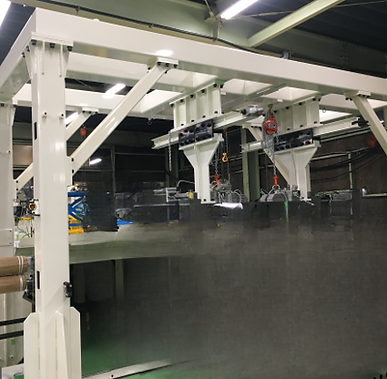

門型タイプ
The die is firmly fixed and can be finely adjusted.


We offer a wide range of services for film T-dies, from new design to production, installation, and post-installation consulting. We also provide consulting for jigs and tools. We can handle even a single heater, so please feel free to contact us with any inquiries, no matter how small.
bottom of page